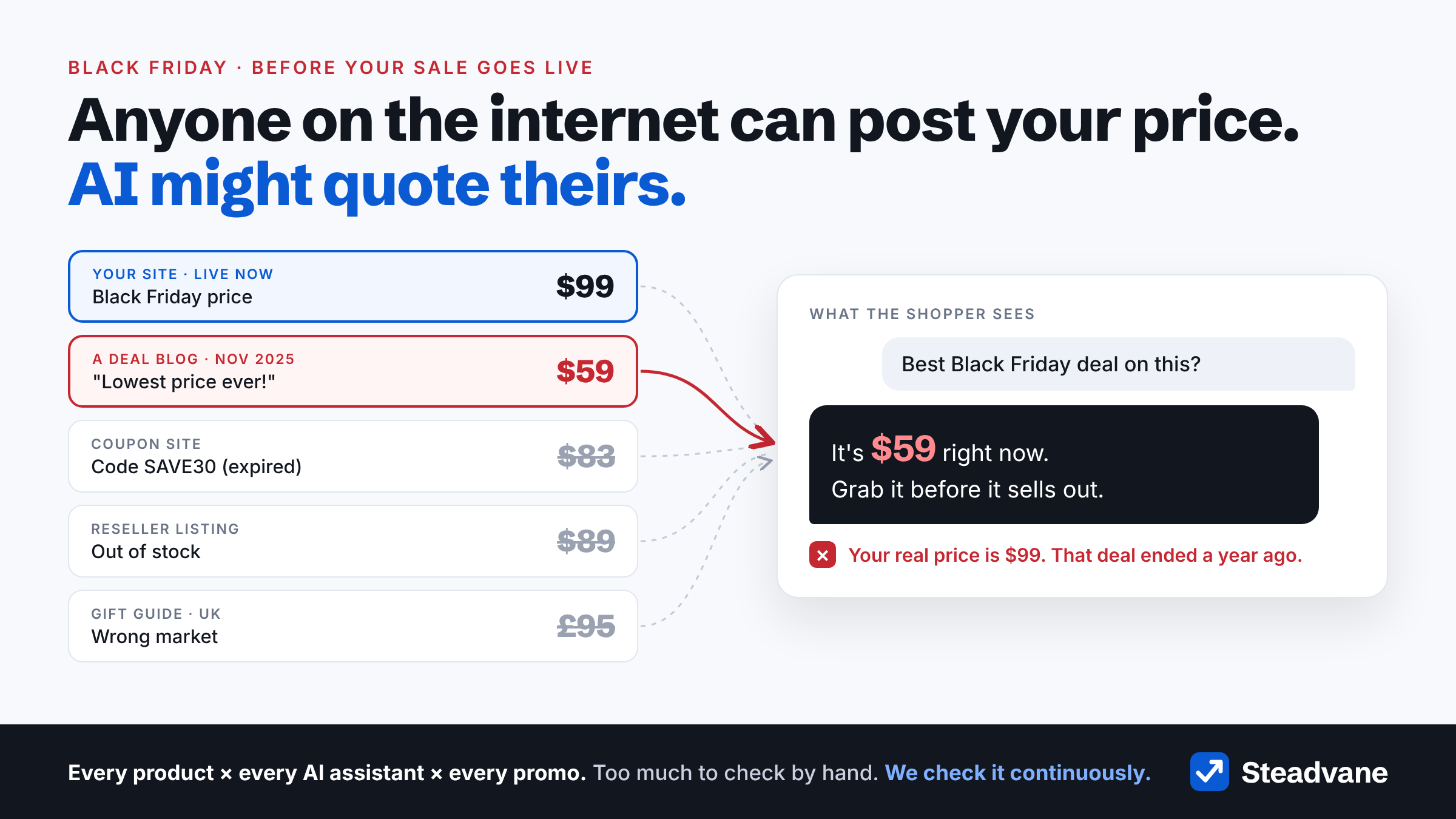
AI is quoting your prices. Is it quoting the right ones?
Your prices change in real time. AI answers don't.
How shoppers used to find you
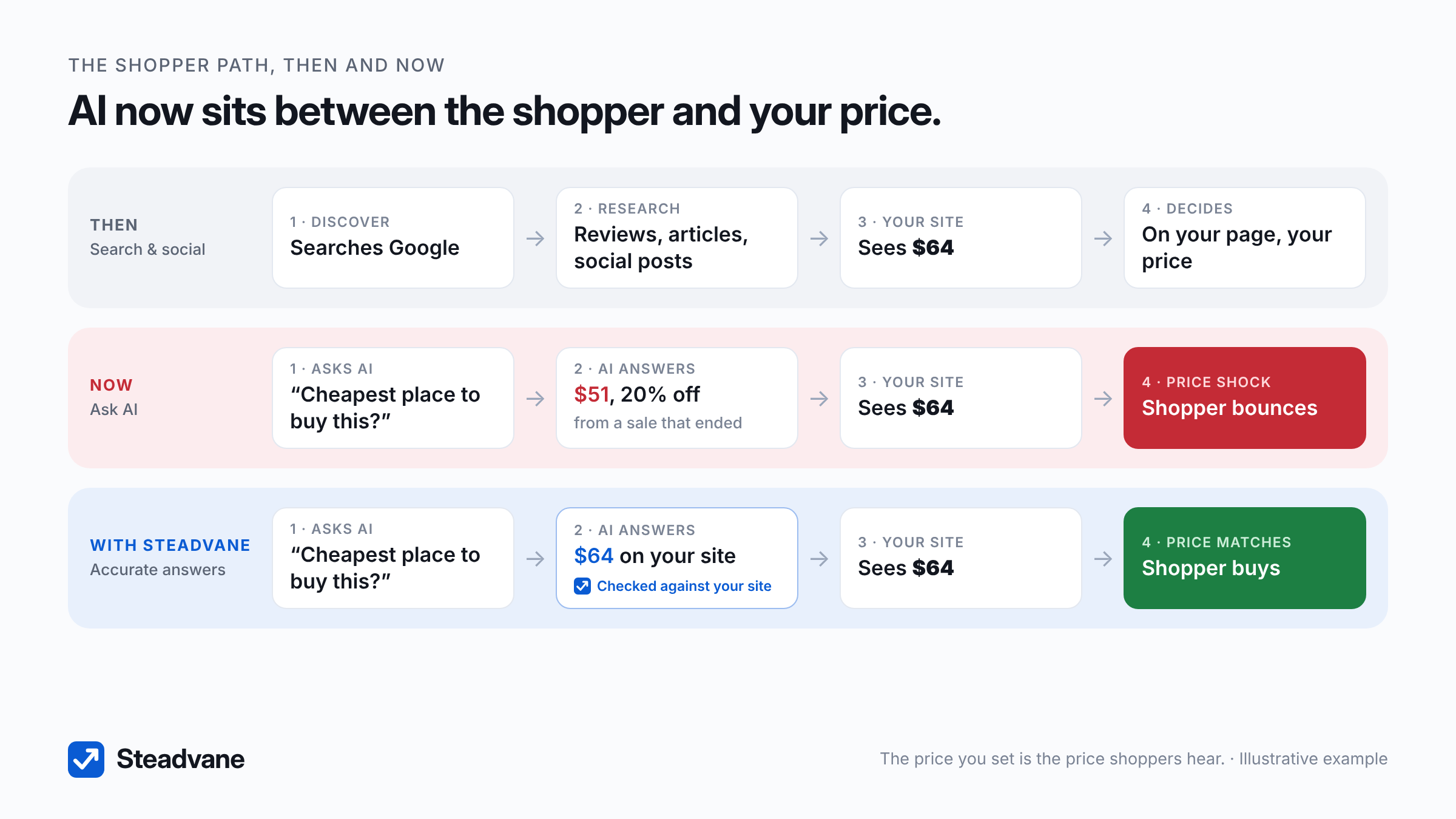
For twenty years the path was familiar. A shopper searched Google. They clicked a review, a gift guide, an Instagram post, a TikTok. They landed on your product page, saw your price, and decided.
Every step of that journey was something your team could see, measure, and shape. You owned the landing page. You owned the price on it. When a promo went live, the shopper saw it.
How they shop now
Today a growing share of shoppers skip the search results and just ask.
"What's the best running shoe under $150?"
"Where's the cheapest place to buy this serum right now?"
ChatGPT, Gemini, Perplexity and Google's AI answers reply with a product, a retailer, and a price. Then the shopper clicks.
This isn't a niche behavior anymore:
- +693%. Generative AI traffic to US retail sites over the 2025 holiday season, year over year. (Adobe)
- +805%. AI referrals to US retail sites between Nov 1 and Black Friday 2025. (Adobe)
- 31% more likely to convert than other traffic, and 33% less likely to leave immediately. (Adobe)
That last line matters most. Shoppers who arrive from AI have already done their research. They're the highest-intent visitors you get.
So what happens when the AI told them the wrong price?
The problem: you don't control the answer
Brands can't decide what an AI model reads or repeats. Answers are stitched together from your site, old cached pages, affiliate roundups, deal sites, marketplaces and expired promo posts. One source says you're on sale. Another says you're not. The AI picks one and says it with confidence.
The numbers are not reassuring:
- 68% of ChatGPT shopping answers had at least one error in a Which? test of 25 products. It named the correct lowest price and retailer for just 8 of 25. (Which?, Oct 2026)
- In that same test, ChatGPT quoted a Chromebook at £399. The real lowest price was £599. The £399 was a sale price from six months earlier.
- When AI shopping answers got a price wrong, they were off by a median of $300, in a study of 220 shopping questions across ChatGPT, Claude, Gemini and Perplexity. (Product.ai, as reported by Tech.co)
What that costs you
Picture it from the shopper's side. The AI says your product is $51 with 20% off. They click through. Your page says $64.
They don't think "the AI was wrong." They think your price changed, or this brand is bait-and-switching me. Then they leave.
- 70% of online carts are already abandoned. (Baymard Institute)
- 40% of shoppers who abandon do it because the extra costs were too high, the total came out above what they expected. (Baymard Institute)
- 58% of AI shoppers say they lose trust in a brand when AI gives wrong product information. (Rithium, via Resultsense)
Price surprise is already the number one checkout killer. AI moves that surprise to the very first click, before your page has a chance to sell.
And it cuts both ways. If AI says you're full price while your sale is live, the shopper never clicks at all. That's a promo you paid for and a competitor got the sale.
Black Friday is ten days away
Black Friday lands on November 27. It's the heaviest pricing week of the year: doorbusters, tiered discounts, bundles, flash deals that start and stop by the hour.
Last year:
- Black Friday drove a record $11.8B in US online spending. (Adobe)
- AI traffic to US retail sites jumped 670% on Cyber Monday. (Adobe)
- AI traffic converted 38% better than other traffic on Black Friday itself. (Adobe)
This year there's more AI traffic, more promos, and more chances for an answer to be quoting last week's price. The shoppers most ready to buy will be the ones most exposed to the mismatch.
How Steadvane keeps AI answers accurate
Steadvane monitors what AI assistants tell shoppers about your prices, promos and stock. We continuously check those answers against your live site, so you know the moment an answer drifts.
When a sale, bundle or price change throws an answer off, we hand you the fix: what's wrong, where the AI is getting it, and what to update so the right price surfaces.
And it doesn't stop after one fix. Prices keep moving, so we keep checking. Sale on, sale off, bundle, member price, out of stock: the price you set is the price shoppers hear.
The takeaway for marketers
You spend real budget on every promo. You measure every click from search, social and paid. AI answers are now a channel too, and right now most brands have no visibility into what that channel is saying.
Before Black Friday, ask an AI assistant about your own best-sellers. Then compare the answer to your site.
If the numbers don't match, we should talk. Get your free snapshot at steadvane.com.
Sources
- Adobe, "Holiday Shopping Season Drove a Record $257.8 Billion Online," Jan 7, 2026. https://news.adobe.com/news/2026/01/adobe-holiday-shopping-season
- Adobe for Business, "AI traffic surges across industries, retail sees biggest gains," Jan 2026. https://business.adobe.com/blog/ai-driven-traffic-surges-across-industries
- RTTNews via Nasdaq, "Black Friday 2025 Sets Record With $11.8 Billion In U.S. Online Sales: Adobe," Nov 30, 2025. https://www.nasdaq.com/articles/black-friday-2025-sets-record-118-billion-us-online-sales-adobe
- Which?, "Can you get a good deal in the sales using AI?", Oct 18, 2026. https://www.which.co.uk/news/article/can-you-get-a-good-deal-in-the-sales-using-ai-aJecz4r1AkR4
- Tech.co, "Study: AI Shopping Assistants Are Wrong 86% of the Time" (reporting Product.ai research), Sep 25, 2026. https://tech.co/news/ai-shopping-assistants-not-ready-holidays
- Baymard Institute, "Cart Abandonment Rate: 50 Statistics & Why People Abandon," updated Oct 28, 2026. https://baymard.com/blog/cart-abandonment-rate-statistics
- Resultsense, "AI chatbots give false facts about 64% of UK retailers" (citing Rithium survey), Jul 16, 2026. https://www.resultsense.com/news/2026-07-16-uk-retail-ai-chatbot-inaccuracies/
The $51 / $64 example is illustrative.